
Evaluating Transition Plans in Japan’s High Emission Sectors 2025 Power Sector
Background and Objective
In 2023, KSI conducted a study to assess the extent to which Japanese high-emitting industries and the banking sector have advanced the formulation of transition plans and published a report “Evaluating Transition Plans in Japan’s High Emission Sectors”. The results showed that while disclosure of historical emission data is progressing, there are challenges in setting 1.5°C-aligned science-based targets, presenting corresponding emission pathways, establishing short-term implementation plans to achieve reduction targets, and defining Scope 3 reduction targets. In the coming years, attention will increasingly focus not only on revising targets to be more ambitious, but also on verifying implementation and actual achievement.
Building on these findings, this study, while following the perspective of the previous one which focused on providing an overview of corporate transition plans, gives greater emphasis on examining the implementation status of transition plans, actual emission reduction performance, and the consistency of business portfolio and capital allocation plans with the stated transition strategies. The study also compares Japanese companies with their international peers to identify current trends and challenges.
Coverage
Five Japanese power companies selected based on market capitalization and emissions
Four overseas companies selected as benchmarking peers based on market capitalization, emissions, country, and TPI*2 assessment
Chubu Electric Power Co., Inc.
Tokyo Electric Power Company Holdings, Incorporated
JERA Co., Inc.
The Kansai Electric Power Co., Inc.
Electric Power Development Co., Ltd. (J-POWER)
(Overseas peer companies)
Korea Electric Power Corporation
SSE plc
Dominion Energy, Inc.
Key Findings
Scope 1 & 2 Emission Reduction Target (Indicator 1.1)
Five Japanese companies and two overseas companies target carbon neutrality by 2050, while SSE targets it by 2040.
JERA and J-POWER, which own thermal power generation assets and account for a large share of Scope 1 & 2 emissions, have set targets covering more than 70% of emissions from their domestic power generation.
Only JERA and SSE have set an emission intensity target.
Scope 3 Emission Reduction Target (Indicator 1.2)
Chubu Electric and TEPCO, whose Scope 3 emissions exceed Scope 1 & 2 emissions, place greater emphasis on reducing CO2 emissions from sold electricity.
Kansai Electric has set Scope 1+2+3 reduction targets, which, if achieved, would make 100% of its domestic power generation operations effectively zero-emission.
Among overseas companies, SSE and Dominion include methane as well as CO2 in their Scope 3 reduction targets.
Ambition Level of Emission Reduction Targets (Indicator 1.3)
None of the Japanese companies explain which scenarios their emissions pathways and targets align with, while Dominion states that its targets are aligned with a 1.5–2.1°C pathway, consistent with the TPI assessment.
SSE is the only one among the eight companies to obtain SBTi certification.
Business Portfolio Plan beyond 2030 (Indicator 1.4)
Renewables dominate future generation mixes at TEPCO and Kansai Electric, while low-carbon thermal power remains dominant at Chubu Electric and J-power. JERA has not disclosed projections or plans.
Overseas, KEPCO and Dominion disclose future power mix with percentage breakdowns.
Scope 1 & 2 Absolute Emissions Reduction Performance (Indicator 2.1)
Over the past three years, emissions at JERA and J-POWER decreased as their power generation lowered, while Chubu Electric and Kansai Electric reduced emissions despite higher electricity sales.
In terms of average annual reduction rates, Chubu Electric and Kansai Electric are on track toward 2030 targets, while JERA, J-POWER and TEPCO need to accelerate reductions.
SScope 1&2 Emissions Intensity Reduction Performance (Indicator 2.1)
Among Japanese companies, Kansai Electric has already fallen below the 2030 average emission factor for all power sources based on Japan’s Long-term Energy Supply and Demand Outlook.
The emissions intensities of the four Japanese companies (except Kansai Electric) remain significantly above the 2030 emission factor for OECD countries under the Stated Policies Scenario.
Scope 3 Absolute Emission Reduction Performance (Indicator 2.2)
Of three Japanese companies with Scope 3 targets, Chubu Electric is on track to meet its FY2025 target. TEPCO is approaching its target but emissions increased by about 20% over the past three years.
Kansai Electric, which has a Scope 1+2+3 target, shows an increasing trend in Scope 3 emissions over the past three years.
Application of Internal Carbon Pricing (Indicator 2.3)
All five Japanese companies apply internal carbon pricing for emissions cost estimation and investment analysis, but price levels vary widely.
Implementation Plan and Progress (Indicator 3.1) Thermal Power Transition Plans
JERA and Kansai Electric plan to phase out coal by increasing hydrogen/ammonia co-firing and using CCS, while J-POWER is expected to retain coal + hydrogen co-firing into the 2040s.
While overseas companies have already phased out coal or set phase-out timelines, Japanese companies have not disclosed timing.
Implementation Plan and Progress (Indicator 3.1) Renewable Energy Development Plans
In Japan, JERA and J-POWER have largely achieved their 2025 targets, while TEPCO and Chubu Electric are below 50% progress toward 2030 targets.
Overseas, SSE revised down its targets due to policy delays, while Dominion aims for 100% renewable electricity sales by 2045 under state law.
Implementation Plan and Progress (Indicator 3.1) Focus area ③ Demand-side Measures
JFE leads with ambitious green steel sales targets, but the effectiveness of the mass balance method remains under scrutiny
Market creation through transparency and dialogue with customers will be critical
Capital Allocation (Indicator 3.4)
Reviewing fossil and non-fossil power investment, only JERA clearly discloses fossil investment among Japanese companies, while all three overseas companies disclose both.
Overseas companies allocate a relatively higher share to grid investment than Japanese companies.
Analysis
The biggest challenge in decarbonizing Japan’s electricity sector is reducing emissions from thermal power generation, which currently accounts for about 70% of the power mix (FY2023), while increasing the share of non-fossil power sources. At the same time, systems are needed to efficiently transmit electricity generated by non-fossil power sources, especially renewable energy, to demand centers through expanded inter-regional transmission capacity and the use of grid-scale battery storage.
To address this issue, the Strategic Energy Plan aims to reduce the share of thermal power generation to 30–40% by FY2040. Power companies are expected to phase out inefficient coal-fired power plants by 2030 (through voluntary efforts), while toward 2040 promoting a shift from coal-fired power generation to LNG thermal power plants, expanding hydrogen and ammonia co-firing ratios, and utilizing CCUS. In addition, the share of renewable energy is planned to increase nationwide from the current level of about 20% to 40–50% by FY2040. All five electric power companies covered in this assessment have announced new renewable energy development plans, although the pace of expansion differs among companies.
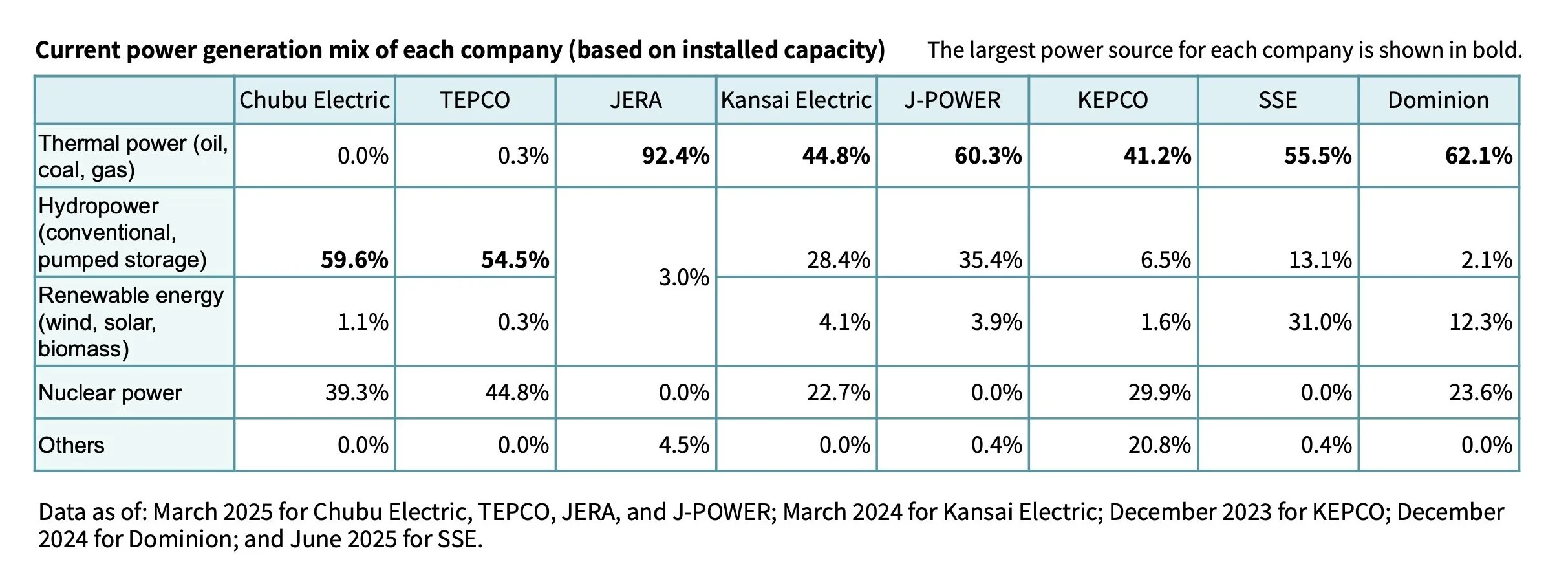
The current power mix of the five Japanese power sector covered in this assessment is shown in the table below.
Chubu Electric and TEPCO have transferred their thermal power generation businesses to JERA. Among the three companies with thermal generation assets, JERA and Kansai Electric plan to phase out inefficient thermal power generation and shift from coal-fired power generation to LNG thermal power plants by 2030, while promoting coal-ammonia co-firing and/or LNG-hydrogen co-firing. They aim to raise co-firing ratios and achieve carbon neutrality in the 2040s through the utilization of CCS. J-POWER also plans to phase out inefficient thermal power generation by around 2035. However, instead of converting to LNG, it plans to replace existing facilities with integrated coal gasification combined cycle (IGCC) plants. Toward the mid-2040s, J-POWER aims to achieve decarbonization through a combination of hydrogen, ammonia, and biomass co-firing at coal-fired power plants together with CCS. (For details, see p.28, Act.1.)
A key concern with these plans is the cost performance of hydrogen and ammonia co-firing. Japan faces resource constraints, including limited domestic natural gas supply and insufficient renewable energy generation capacity, making it necessary to rely on imports for hydrogen and ammonia procurement. Ammonia co-firing is particularly costly due to the need for low-carbon hydrogen production, conversion to ammonia, and transportation. According to estimates by Rystad Energy, an energy market research and analysis firm, assuming a low-carbon hydrogen price of USD 5/kg (equivalent to an ammonia price of USD 1,000/ton), the levelized cost of electricity for fuel with 10% ammonia co-firing is expected to be approximately 50% higher than coal-fired power generation alone.(*1)
Even if hydrogen prices decline and higher hydrogen and ammonia co-firing ratios become achievable, utilization rates of thermal power generation are likely to be reduced as renewable energy supply becomes more stable nationwide. In addition, as carbon prices rise over time, thermal power generation may face profitability challenges(*2).
Not only thermal power plants themselves, but also fossil fuel-related assets—including mining rights, LNG interests, LNG receiving terminals, and long-term fossil fuel procurement contracts—could face the risk of becoming stranded assets as carbon prices increase. At Dominion in the United States, one of the global peers in this assessment, a majority of shareholders voted in favor of a proposal at the FY2022 annual shareholders meeting requesting disclosure on the potential for natural gas assets to become stranded assets during the transition period.
While company disclosures indicate that certain risks have been assessed through scenario analysis based on the TCFD recommendations, these assessments do not yet appear to be linked to concrete actions such as phased divestment of thermal power assets or targets to eliminate coal-fired power generation, as seen among some overseas peers. In addition, medium- to long-term investment plans do not clearly specify investment amounts for fossil-fuel-based power sources, making the relative allocation between fossil and non-fossil power sources unclear. This lack of clarity raises concerns over whether the transition of thermal power generation and related assets will proceed steadily. This raises concerns about carbon lock-in in Japan’s electricity sector.
Four Japanese companies (excluding JERA) disclose plans and projections for their future power generation mixes. However, as these are presented only in graphical form without numerical data, the exact share of each power source cannot be determined. Although uncertainties such as geopolitical risks, carbon pricing, inflation, and interest rates are common to overseas companies as well, KEPCO discloses its 2038 power mix and Dominion its 2035 mix in percentage terms, demonstrating their commitment (for KEPCO, the renewable energy ratio is yet to be determined). Although SSE does not present a future power mix, it clearly communicates its strategic direction. The company provides detailed investment allocation (38% to non-fossil power, 8% to fossil power, and 60% to the grid over the five years to 2027), explains the risk of failing to achieve its 2030 renewable energy development targets due to delays in national energy policy and the corresponding mitigation measures, and states that investment in thermal power must be consistent with full decarbonization by 2035. This demonstrates a clear transition strategy that takes account of external uncertainties. Such an approach may provide a useful model for Japanese companies.
Capital Allocation and Policy
In disclosed investment plans, the investment amount in fossil power is unclear compared to that in non-fossil power such as renewables and nuclear. Among the five Japanese companies, only JERA provides both fossil and non-fossil investment amounts, while for Kansai Electric and J-POWER, thermal power investment is disclosed together with other uses and is not clearly specified. This contrasts with global peers that disclose fossil investment in the same way as non-fossil investment.
Regarding investment policy, SSE’s disclosure of the conditions and criteria underpinning its investment decisions while also considering uncertainties provides investors with greater transparency and a clearer cases for assessment. (see p.30, Act.2 for details).
Response to Methane Emissions
As noted, JERA and Kansai Electric are shifting from coal to LNG, with long-term procurement of 35 million and 13 million tons per year, respectively. LNG involves methane leakage risks across extraction, production, and transport, and methane emissions—more potent than CO₂—have been increasing in recent years. In Europe, as part of efforts to curb methane emissions, importers—in addition to operators involved in oil and natural gas extraction—will be required to report their import volumes and sources from May 2025, MRV (monitoring, reporting and verification) requirements from January 2027, and methane intensity reporting from August 2028. While such regulation is not yet in place in Japan, investor groups are developing bond investment guidance (*3), and financial institutions are also encouraging methane reduction through financing.
Emission Factor Targets
Reviewing emission reduction targets of the five companies, all set absolute reduction targets covering over 70% of their domestic power generation. However, only JERA (and only SSE among global peers) sets targets for emission intensity. Unlike total emissions based on generation (sales) volume, emission intensity reflects reduction efforts in generation methods and is also important as it affects customers’ Scope 2 emissions.
Comparing FY2024 intensity levels with Japan’s 2030 benchmark and the OECD 2030 benchmark (source: Transition Pathway Initiative), three companies (excluding Kansai Electric and Chubu Electric) show no sign of reaching the former, and four (excluding Kansai Electric) remain significantly above the latter. Companies are expected to set targets not only for total emissions but also for emission intensity.
Just Transition
No disclosure on just transition was found in annual reports, climate strategies (including TCFD), or medium-term business plans of the five Japanese companies. In contrast, two overseas peers—SSE and Dominion—provide detailed disclosure. SSE claims it first published a just transition strategy in 2020 (not verified in this report), updated the strategy in 2024, and set KPIs to track progress. Dominion outlined its policy in 2024 that include community engagement, employee reskilling, and future asset use, and published a booklet titled; Just Transition Highlights, noting impacts of plant closures and dialogue with governments.
The power sector is a critical public utility, and sustainable operations through job protection and coexistence with local communities are particularly important. We encourage Japanese power companies to enhance disclosure in these areas going forward.